- fired to acquired
- Posts
- When Your Audience Becomes Your Product Team
When Your Audience Becomes Your Product Team
The building in public playbook: daily posts, real feedback, and why 120k weekly impressions beats a focus group
In partnership with

Building Loud
Happy Friday! I'm thrilled to be back with another edition of Building Loud! The best newsletter in the game for building in Public.
This week, I have been stalking the likes of X and LinkedIn to find the best growth hacks, the best posts and the best random bits of knowledge
MVP (Most valuable Poster)
🌎 The 2nd Exit: Building in Public Actually Works
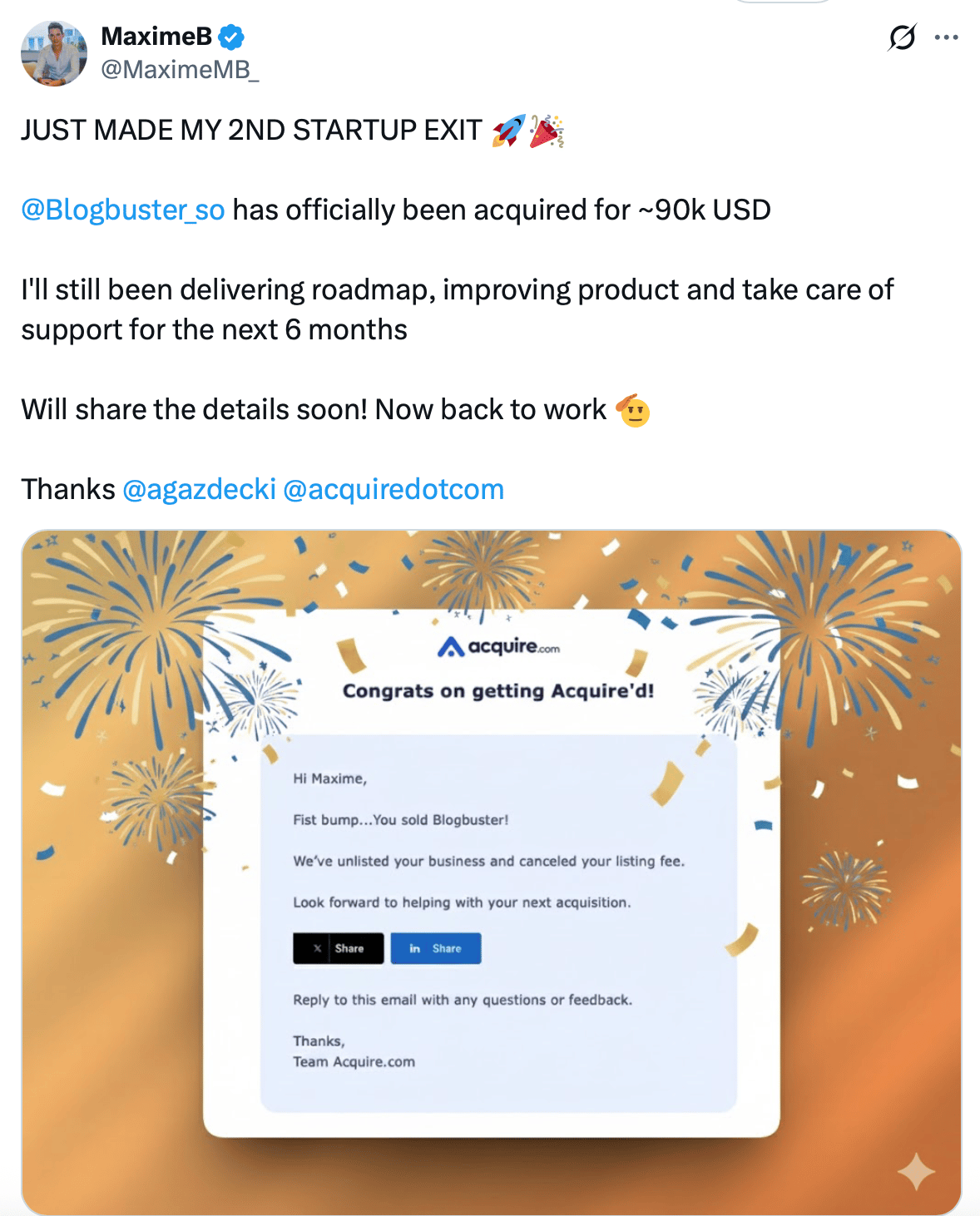
Who: MaximeB (@MaximeMB_) — Serial founder, 2x acquirer, and master of the "build in public → acquire → build again" cycle.
The Story: MaximeB just exited his second startup, Blogbuster, acquired for ~90k USD. But what's more interesting than the exit itself is how he's already building his next thing—and doing it completely transparently on X.
Why He Crushed It:
1. Become Your Own Customer (Dog Food It)
His most recent posts show him using his own product, Mediaboost, to promote Mediaboost itself. He's not hiding behind case studies, he’s showing his audience the benefits and wins he gets from his own product This tells his audience: "This works because I use it."
2. Leverage the Exit for Authority, Then Immediately Ship
Most founders would milk an acquisition announcement for months. MaximeB? He announced Blogbuster's ~90k exit, committed to 6 months of support, and immediately pivoted to building Mediaboost in the open. The message: "I know how to build and exit. Watch me do it again."
3. Teach While You Build
His posts aren't just "Look what I built." They're educational:
He's teaching about AIO (Artificial Intelligence Optimisation)—how ChatGPT and AI models reference media placements
He's showing how a brand-new domain (Mediaboost) got published in 480+ top global media outlets within days
He's pointing out product gaps in competitors (ChatGPT's "think mode" formatting issues) while subtly positioning his solution
4. Real-Life Networking > X-Only Networking
He's not some terminally online founder. He posted about flying to Ho Chi Minh to network in person while also maintaining his X presence. This dual approach signals: "I'm serious about this, not just chasing clout online."
5. Transparency About Product Usage
When he says "I am a client of my own product," he's not just boasting—he's building trust. His audience knows Mediaboost works because he's using it to grow Mediaboost. That's the anti-BS move.
The Exit Pattern:
What makes MaximeB's journey so interesting is that it's repeatable:
Build product in public (Blogbuster)
Get acquired
Commit to quality handoff
Build next product even more openly (Mediaboost)
Attract next round of investors, partners, acquirers
He's proving that building in public isn't about getting followers—it's about attracting the right people (acquirers, customers, partners) who've been watching your execution.
The Lesson for You
Exit isn't the end—it's a credibility reset. Use an acquisition to build authority for your next venture.
Be your own best customer. If you can't use your product, why would anyone else?
Teach as you build. Every product insight is content.
Mix online and offline. X visibility + real-life networking = sustainable growth.
Speed matters. From exit announcement to new product launch in days shows serious execution.
Differentiation Playbook
Building in Public as Customer Research: The Rally Up Case Study

The Premise:
Most founders treat their audience like a broadcast channel: "Here's my product, buy it." Alec Kremins (founder of Rally Up) flipped the script entirely. He treats his LinkedIn audience like his product development team.
The Story:
Alec didn't start from zero. He had 15,000+ followers and significant credibility from his time at Beehiiv. But here's what matters: he didn't coast on that.
Instead, he made a deliberate choice: build Rally Up completely in the open. Every pivot. Every stumble. Every win. All of it posted to his 15,000 followers.
The Results:
120,000 impressions per week (not from viral fluff—from consistent, transparent updates)
Investors reaching out unprompted (because they watched the execution unfold)
Interns wanting to join (they saw the real journey, not a polished pitch deck)
Developers offering to help (they believed in the mission because Alec proved he'd execute)
Customers signing up (because they witnessed the entire build, not just the final product)
How He Used His Audience as Beta Testers:
1. Share the Process, Not Just the Product
Alec didn't wait for Rally Up to be "perfect" before posting. He posted about the messy middle—the pivots, the failed experiments, the hard decisions. This did two things:
His audience became invested in why certain features existed
People started suggesting improvements before they were fully baked
He gathered real feedback from his target market (LinkedIn users, founders, salespeople) without needing a formal survey
2. Daily Posts = Daily Feedback Loop
By posting daily about Rally Up's journey, Alec created a continuous conversation with his audience. Comments became feature requests. Questions became product insights. Criticism became roadmap validation.
This is customer research on steroids—instead of scheduling quarterly user interviews, he got real-time feedback every single day.
3. Transparency Builds Trust (Which Converts)
Here's the psychological shift: when Alec shared the stumbles and pivots, people believed him more. They saw:
A founder who wasn't bullshitting
A product that was actually solving real problems (because he was talking about them publicly)
A mission worth believing in (because the vulnerability was genuine)
That trust converted into investors, interns, developers, and customers.
4. The "Show the Process" Play
Alec's killer move: he showed Rally Up working for his own use case. He wasn't just telling people to use it—he was using it himself and narrating the results. This is the "eat your own dog food" strategy on steroids.
People could see: "Oh, this is how Rally Up actually works. This is how it solves my problem too."
Why This Matters for Customer Research:
Traditional customer research is slow and expensive:
Schedule interviews (hard to find time)
Record and transcribe (time-consuming)
Analyze feedback (delayed insights)
Building in public as research:
Real-time feedback from your actual audience
Self-selected respondents (people who genuinely care)
Immediate iteration based on comments
Built-in social proof (others see the improvements happening)
The Trap: Performative "Building in Public"
Not all building in public is created equal. Here's what doesn't work:
Highlight reel only: Posting wins without mentioning struggles. Your audience can smell BS.
No actual iteration: Asking for feedback but ignoring it. People notice and stop engaging.
Too much noise: Posting 10 times a day with no substance. This is spam, not research.
No skin in the game: Telling others to use your product while you don't. Credibility killer.
Alec avoided all these traps. He was genuinely building, genuinely iterating, genuinely struggling—and genuinely sharing it all.
What RallyUp Readers Should Learn:
Your audience wants to help you build. Let them.
Daily posting + real updates = continuous customer research
Transparency about struggles builds more trust than perfection
Use your own product relentlessly (and show it)
Comments aren't just vanity metrics—they're your product roadmap
Building in public isn't marketing; it's product development in public
The Takeaway:
Alec didn't go viral with hype. He built a following by being real, sharing the journey, and treating his audience like partners in the process. That's why investors came. That's why customers came. That's why Rally Up is where it is today.
If you're building something, stop thinking of your audience as people to sell to. Think of them as your beta testers, your advisors, your first customers. Share the process. Listen to the feedback. Iterate in public.
That's building in public done right.
Weekly Challenge
Share Your Stumble

Post about a pivot, failure, or hard decision you made this week while building. Don't sanitise it. Real people, real problems. Tag us with #BuildingLoud, and we'll feature the most honest one next week
Takeaway: Share Your Failures with the Public! You may hate it, but trust me, your audience will love it. It makes your more trusting and gives everyone else a good laugh
Startups who switch to Intercom can save up to $12,000/year

Startups who read beehiiv can receive a 90% discount on Intercom's AI-first customer service platform, plus Fin—the #1 AI agent for customer service—free for a full year.
That's like having a full-time human support agent at no cost.
What’s included?
6 Advanced Seats
Fin Copilot for free
300 Fin Resolutions per month
Who’s eligible?
Intercom’s program is for high-growth, high-potential companies that are:
Up to series A (including A)
Currently not an Intercom customer
Up to 15 employees
Useful Tat:
🛠️ Tool Stack of the Week:
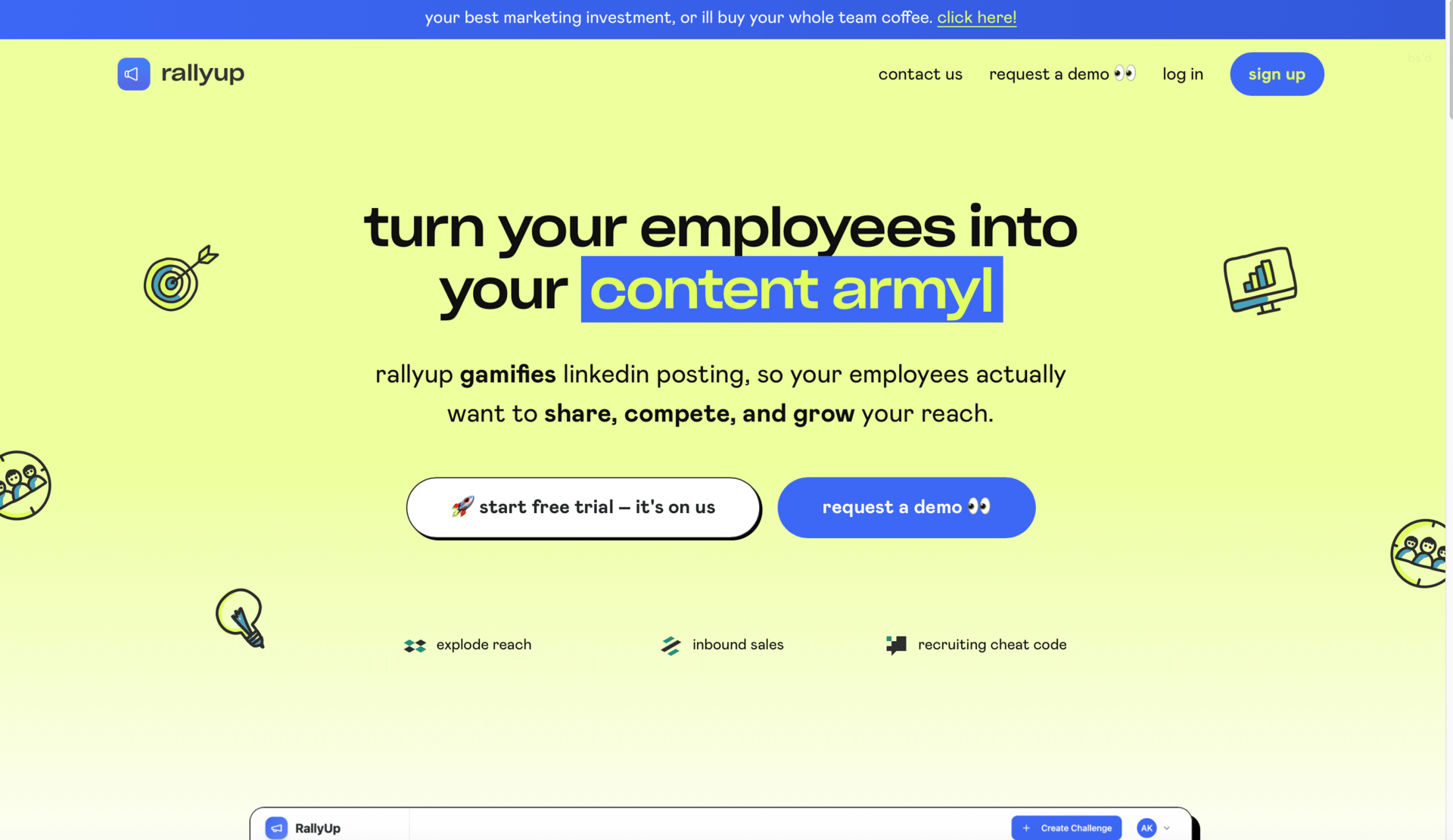
Rally up Landing Page
If you want to be posting on linkedln like a pro you have to get yourself onto Rally up
Until next time dont forget to keep posting!
Chris